


California Homebuyers Are Getting Older: Why Buying a Home at 40 or 45 Is Becoming Normal
- Michael Belfor

- 18 minutes ago
- 5 min read
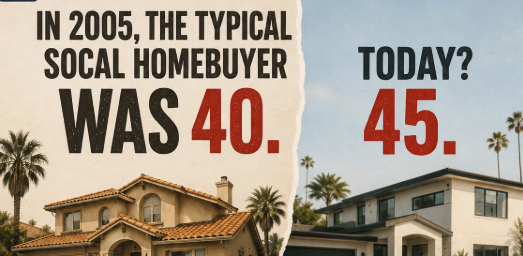
If you feel like people are buying their first or next home later in life than they used to, you're not imagining it.
A new Los Angeles Times analysis of Southern California housing data found something striking:
The typical Southern California homebuyer was about 40 years old in 2005. Today, that buyer is around 45.
Five years may not sound dramatic.
But it says a lot about what has happened to homeownership in California over the last two decades.
California Homeownership Didn't Disappear. It Got Delayed.
For generations, there was an unofficial American timeline:
Graduate.
Get a job.
Get married.
Buy a house.
Have kids.
Do all of that somewhere around your late 20s or early 30s.
California housing has increasingly blown that timeline apart.
According to the California Association of Realtors, buyers today are entering the housing market later and saving longer as home prices, mortgage rates, living expenses and years of limited housing supply make ownership harder to reach.
That's especially noticeable in Southern California.
The typical buyer in the recent comparison is older and earns more than the typical buyer did two decades ago.
But they're also paying substantially more for the home.
The Southern California Buyer: 2005 vs. Today
The numbers tell the story.
2005
Typical Southern California buyer:
Age: 40
Income: approximately $92,500
Home price: approximately $525,000
Home size: approximately 1,600 square feet
Today
The more recent buyer profile:
Age: 45
Income: approximately $160,000
Home price: approximately $820,000
Home size: approximately 1,700 square feet
So the buyer earns considerably more money.
But they're also older, have generally spent longer saving and are buying a home that costs hundreds of thousands of dollars more.
And after all of that?
They're getting roughly 100 additional square feet.
Welcome to California.
Income Went Up. So Did the Bar to Get In.
It's tempting to look at $92,500 in 2005 versus $160,000 today and conclude that today's buyer is simply wealthier.
Inflation changes that picture.
The Los Angeles Times noted that the 2005 buyer's $92,500 income would translate to more than $150,000 in 2025 dollars.
In other words, purchasing power hasn't remotely increased at the same pace that the raw income figures suggest.
Housing costs have remained incredibly difficult relative to what California households earn.
For additional context, the California Association of Realtors reported that only 18% of California households could afford the state's median-priced existing single-family home in the fourth quarter of 2025.
That home cost $869,300.
A household needed an estimated annual income of approximately $213,200 to afford it under C.A.R.'s assumptions.
That's not exactly a starter-home-friendly environment.
## But There's One Huge Difference Between Today and 2005
Anyone who lived through the housing crash understandably gets nervous when today's affordability problems are compared with the mid-2000s.
But the mortgage markets are dramatically different.
The early 2000s were the era of:
Stated-income loans.
No-documentation loans.
100% financing.
Option ARMs.
Extremely loose underwriting.
And plenty of loans being made to people who were poorly positioned to handle them if something went wrong.
Today's mortgage environment is far more heavily documented.
Income gets verified.
Assets get verified.
Employment gets verified.
Credit and debt obligations are reviewed.
And according to the Times analysis, today's buyers generally put more money down than buyers did during the looser lending environment of the early 2000s.
That doesn't make today's homes affordable.
But it does mean "housing is expensive again" and "we're repeating 2005" are not the same statement.
Today's California Buyer Is Often Better Prepared — Because They Have to Be
There's another way to interpret the age difference.
A 45-year-old buyer may have had additional time to:
Build a career.
Increase income.
Accumulate retirement assets.
Save a larger down payment.
Pay down debt.
Build credit.
Develop home equity from a previous property.
Or combine finances with a spouse or partner.
That's increasingly what it takes to compete in expensive California markets.
The downside is obvious: households without those advantages face an increasingly difficult path into ownership.
There's another interesting affordability gap hiding in California's numbers.
C.A.R. reported that in late 2025, a typical California condo or townhome cost approximately $650,000, compared with $869,300 for the median existing single-family home.
The estimated income needed to afford the condo was approximately $159,200, compared with $213,200 for the single-family home.
That's a difference of more than $50,000 in required household income.
For some buyers, the traditional starter house may therefore be replaced by:
A condo.
A townhome.
A smaller property.
A different city.
A duplex.
A home with an ADU.
Or simply buying later.
None of those paths necessarily look like the version of homeownership previous generations imagined.
That doesn't make them wrong.
Buying Your First Home at 40 Isn't Failing
This may be the most important takeaway.
People understandably compare themselves with their parents.
“My parents bought at 27.”
“My dad bought his first house on one salary.”
“My parents paid $180,000 for a house that's worth $1.2 million now.”
Those stories can all be true.
But you're operating in a completely different housing market.
California home prices, wages, interest rates, childcare costs, student debt, insurance expenses and the overall cost of living have changed dramatically.
The timeline changed with them.
Buying at 35, 40 or 45 doesn't mean you're late.
It means the economics surrounding homeownership changed.
Don't Buy Because You Think You're Supposed To
There's also a danger in taking the opposite lesson from this data.
You shouldn't rush into buying a house because you're worried you're “behind.”
Homeownership makes sense when the numbers and your life make sense.
That means looking at more than the maximum purchase price a lender says you qualify for.
Look at:
* The monthly payment you're actually comfortable with
* Your emergency reserves after closing
* How long you expect to stay
* Your career and income stability
* Your other financial goals
* The neighborhood and lifestyle you want
* Whether a condo, townhome, ADU or different market changes the equation
* Whether buying now actually improves your situation compared with renting
There isn't a universal age when buying becomes the correct decision.
The California Homebuyer Has Changed
The biggest story isn't simply that the typical Southern California buyer went from roughly age 40 to 45.
It's why.
Buyers are entering later.
They're saving longer.
They're earning more.
They're putting more money into transactions.
And they're still dealing with some of the most challenging housing affordability in America.
The old homeownership timeline may no longer fit California.
And that's okay.
Timing is personal. Homeownership is possible. The plan just has to make sense for your actual life — not somebody else's timeline.
---
Mike Belfor MLO 264700
Belfor Team | American Pacific Mortgage
Housing statistics are market-level data and do not represent the price, qualification or availability of any individual property or mortgage. Loan qualification varies by borrower, property and loan program.


Comments